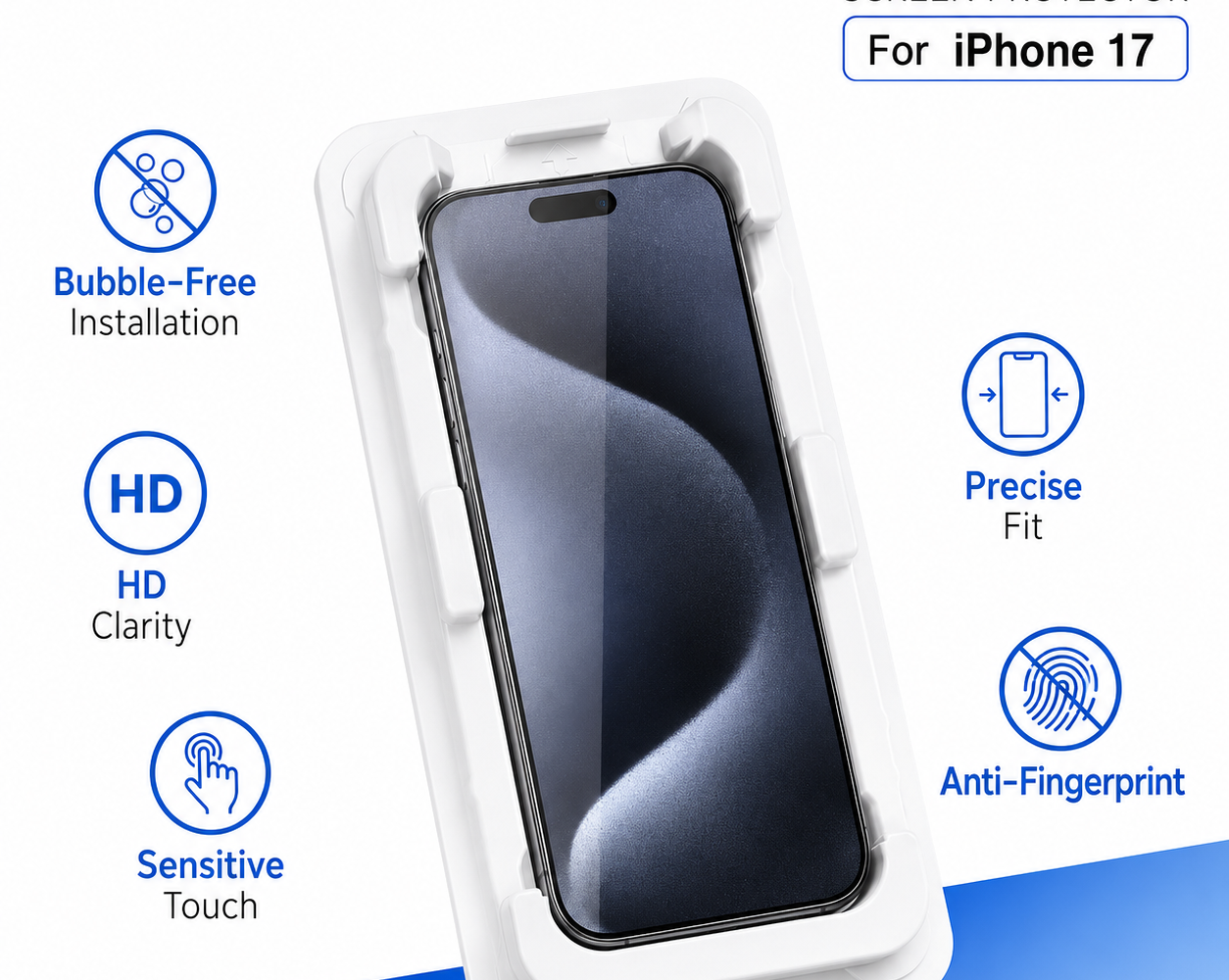
Client: APEI, tempered-glass screen protector manufacturer, China
Engagement: Brand positioning, website, content-to-demand system, Australian market launch, global presence
Result headline: 60 qualified B2B enquiries in 12 months, from a standing start, across Australia, the UK, and India
The situation
APEI had spent fourteen years doing the hard part well. A production facility running since 2010. Glass cutting, chemical tempering, electroplating, adhesive bonding, and six quality-control checkpoints on every single unit, with no sampling. On the metrics that matter to a serious buyer, the product held up.
What APEI did not have was a brand. To the market, it was one more factory in a spreadsheet of interchangeable quote requests.
We did not wait for them to find us. We saw a manufacturer with real, provable quality and no way to command a price for it, and we approached them.
The complication
Good quality a buyer cannot see is quality a buyer will not pay for.
Because nothing distinguished APEI from cheaper factories on the surface, every conversation collapsed to the same question: what is your price? The company was forced to compete in a race it should never have been in. Real, tested, provable quality sat inside the product, and priced in at zero, because the buyer had no way to verify it before ordering. Margin was quietly left on the table on every deal.
The diagnosis (the verdict)
This is where most people misread the problem and reach for more ads, more listings, more “awareness.”
It was not an awareness problem. It was not an advertising problem. It was a legibility problem. The quality existed, but it was invisible and unverifiable, so it could not command a price. In a market where every supplier makes the same vague claims, “premium,” “high quality,” “durable,” the claims themselves had become worthless.
The winning move was not to claim louder. It was to make the quality provable.
The intervention
Four moves, in sequence.
1. Repositioned around proof, not promises. We built the brand on a single defensible idea: a manufacturer that publishes its standards. Not “premium,” but edge-pressure ratings in KGS. Not “durable,” but 20,000-cycle wear-test results and ball-drop data. Not “trust us,” but verifiable specifications any buyer could check before ordering. In a category of adjectives, APEI became the one brand speaking in numbers.
2. Built the proof hub: a spec-led website. A website that put the proof front and centre: substrate, thickness, coating method, adhesive grade, wear-test results, edge pressure, ball-drop ratings, QC process, and the facility itself. The site does not ask buyers to believe. It lets them verify. Every design and copy decision reinforced one message: this is a manufacturer with nothing to hide.
3. Turned the proof into a content-to-demand engine. One source of truth, APEI’s verified specifications and test data, repurposed into every channel a modern B2B buyer actually uses:
- Blog and buyer guides (SEO). A content system that scales APEI’s spec expertise into the exact questions buyers search: “high aluminium vs Corning glass,” “how to choose an OEM screen-protector supplier,” and device- and market-specific buyer guides. The verified spec data is the moat, so the content is genuinely useful, not filler.
- Answer-engine optimisation (AEO / GEO). Buyers increasingly ask ChatGPT, Perplexity, and Google’s AI Overviews “who makes tempered-glass screen protectors with Corning glass” before they open a browser tab. Structured, verifiable specification data is exactly what those engines cite. The same “publish the specs” positioning that repositioned the brand also made APEI the most citable supplier in its category. We engineered the content to be the source the AI answers from, not a page buried in blue links.
- Social proof content (TikTok, Instagram, Reels). The footage that proves the quality, ball-drop tests, 20,000-cycle wear tests, the QC line, the factory floor, is inherently visual and social-native. The same proof that convinces a buyer is the content that travels. Manufacturing-floor and test content built discovery and credibility on channels most factories ignore completely.
The through-line: one proof asset, every channel. Specs and test footage feed the website, the buyer guides, the AI answer engines, and social, as a coordinated system, not scattered posting.
4. Launched deliberately, then let demand pull. Rather than spraying effort across every market, we launched properly in one, Australia, and let the engine work. Within twelve months it was pulling enquiries the brand had never seen before, unprompted, from the UK and India.
The results
In twelve months, from a standing start with no prior web presence, APEI went from an anonymous supplier to a spec-led brand generating inbound B2B demand across three continents.
- 60 qualified B2B enquiries in 12 months
- Inbound interest across three continents: Australia (the deliberate launch market), plus the UK and India, unprompted
- Demand that arrived through positioning and proof, not paid awareness